Identify the release before comparing listings
Build a short identification record: full title, release year, medium, sheet dimensions, edition notation and colorway. The title is the starting point, not the complete identity. A seller’s abbreviation may omit the color or another distinction that matters when you compare two examples. Ask for a photograph of any text or numbering cropped from the main listing image.
Use the OBEY archive to check the claimed release, then compare its details with the actual photographs. An archive entry establishes that a release exists; it does not authenticate every print carrying that title. If measurements differ, ask whether the seller measured the image, the whole sheet or the frame. Those are three different measurements.
Screen print, offset and letterpress are different choices
Buy the format you actually want. A collector looking for the surface character of a screen print should not assume that every signed Fairey image uses that process. Likewise, a smaller letterpress work can be an intentional format rather than a reduced substitute for a larger sheet. Read the medium in the listing and the release record together.
When choosing between formats, think about viewing distance, wall space and framing. A strongly graphic composition may read well across a room, while paper texture and close details invite nearer viewing. Ask for one straight-on image and one gently angled image so that light does not flatten every surface into the same appearance.
Read signatures and edition marks separately
A signature and an edition number answer different questions. Record both exactly as written. Do not turn a partially hidden number into an assumption about the edition size, and do not infer a proof designation from the seller’s title alone. A photograph of the mark should support the description.
Numbered copies of the same release should be evaluated by their own condition and documentation. A low number is not, by itself, evidence that a sheet was printed first or printed better. If your collecting preference is a particular number, treat that as a personal preference rather than a quality grade.
Look closely at margins and dense ink areas
A frontal image can hide shallow handling creases, corner bends and abrasion. Request detail photographs of the four corners, lower margin and any area the seller has identified as imperfect. Where a composition contains large solid ink areas, angled light can help distinguish reflection from a surface disturbance. It should supplement ordinary photographs, not replace them.
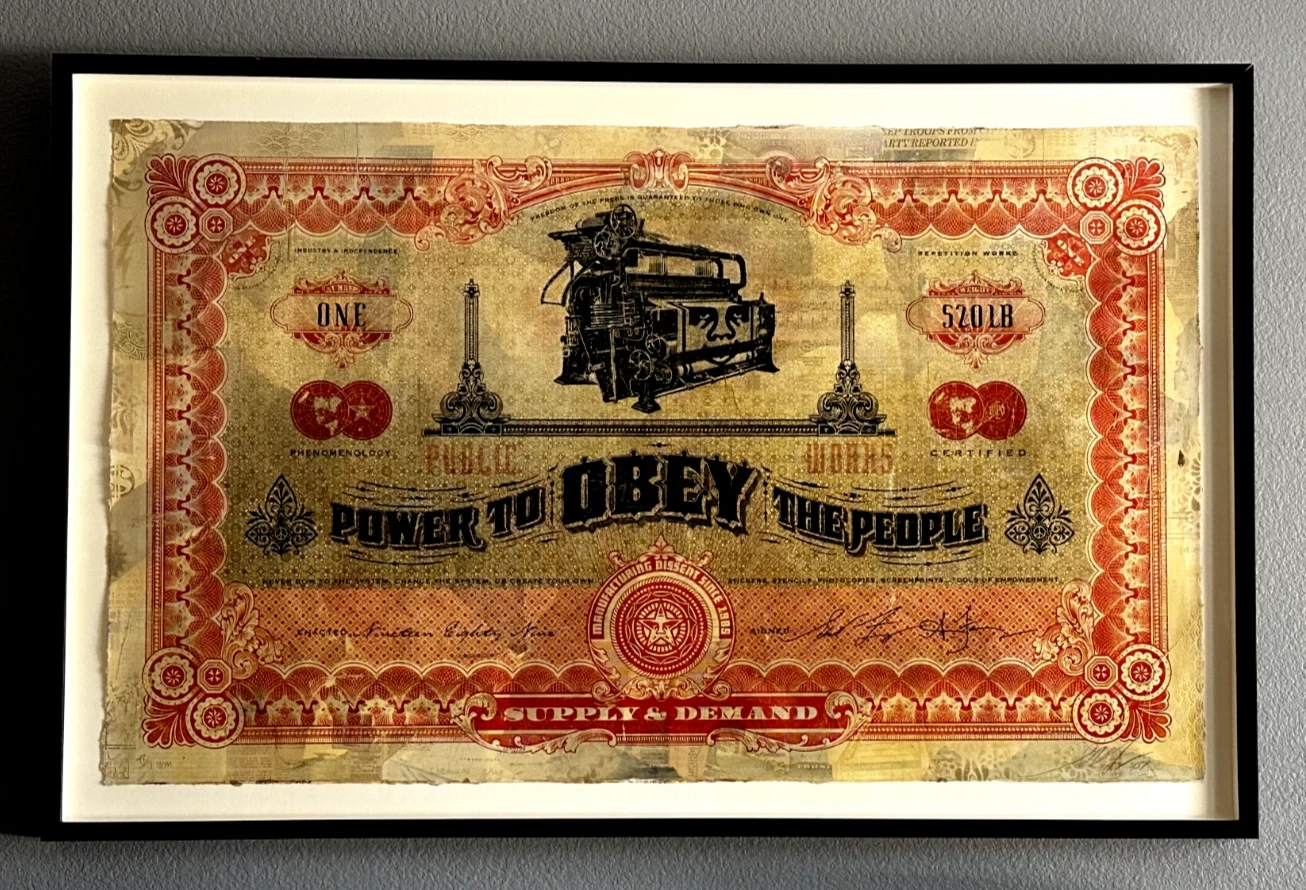
For framed prints, find out whether the visible opening hides part of the sheet. Ask whether the work has been examined out of the frame and whether mounting materials touch the paper. A frame can look excellent while concealing edge issues. A seller who has not opened it should state that limitation rather than guess.
Keep release documentation with the work
Save the invoice, listing photographs and any original order record. OBEY’s FAQ explains that certificate availability varies by release and that some older purchases do not have retroactive certificates. Therefore, the absence of a digital certificate is not a universal test for rejecting older Fairey prints. Conversely, a certificate should be matched to the specific work instead of accepted as a substitute for inspection.
If a listing includes digital documentation, ask what accompanies the sale and how the seller will complete any applicable transfer. Keep private account information out of public resale photographs. The useful record is one that connects the physical sheet, its identifying details and its documented history.
Choose a coherent collecting direction
You can organize a Fairey collection around a theme, a printing format, a visual palette or a group intended to hang together. Decide which matters most before browsing. This makes it easier to pass on an appealing but unrelated work instead of accumulating sheets that have no place in your display plan.
Explore TrendingArt’s fine-art pages and current eBay listings for the available selection. Check each listing for photographs, condition, format and transaction terms. This artist page is a collecting reference and does not imply that any particular Fairey release remains in stock.
Common questions
Does a familiar OBEY image identify the edition?+
No. Verify the full title, medium, colorway and dimensions. A shared image can appear in more than one format, so comparing only the central design can produce a misleading match.
Sources & further reading
Primary references for the terminology and factual details discussed above.
Explore the actual listings.
Read the item description, photographs, condition notes and terms on eBay. Selection and availability change.
Browse Current Art Inventory ↗Explore Collectible & Contemporary Art ↗