1948 Bowman: the postwar starting point
The 108-card issue uses small black-and-white photographs. It is a separate checklist from 1948 Leaf, not a monochrome edition of that set. Sammy Baugh and Sid Luckman are useful starting points for understanding the issue. Check both borders and the photograph for creases that disappear in a distant slab image.
1950 Bowman: color after a gap
Bowman returned to football after skipping 1949. The 144 cards remain small, at about 2-1/16 by 2-1/2 inches. Painted player images give the issue a different character from 1948. A listing described simply as a “1950s Bowman” leaves too much unresolved for a serious comparison.
1951 Bowman: a taller format
The 144-card 1951 issue increases the height to about 3-1/8 inches and puts the player’s name in a front label. The similar painted style should not cause confusion with 1950. Measure a raw card only with a safe, nonabrasive method; do not force it into a holder intended for a smaller issue.
1952 Bowman Large and 1952 Bowman Small
These are distinct size formats of the same 144-subject issue, not two grading descriptions. Large cards are approximately 2-1/2 by 3-3/4 inches; Small cards are approximately 2-1/16 by 3-1/8. Frank Gifford and the final-card Jim Lansford are notable collecting targets. Store format as a separate checklist field so a Small card never accidentally fills a Large slot.
1953 Bowman and 1954 Bowman
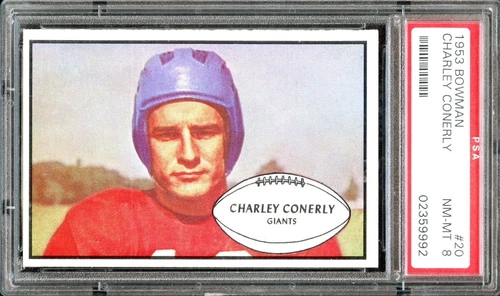
The 1953 set has 96 cards and a football-shaped area containing the player and team names. The 1954 set expands the checklist; compare the actual year’s reverse and design rather than assuming all large Bowman cards belong to 1952. For a run collection, one representative card from each year can show design changes before you commit to complete sets.
1955 Bowman: the final original Bowman season
The 160-card finale retains the larger 2-1/2 by 3-3/4-inch format. It belongs beside, rather than inside, the separate 1955 Topps All-American college-history issue. Inspect centering and the colored design independently of corner sharpness. An appealing lower-grade portrait can be a better fit for a display collection than a higher number with distracting print defects.
Sources & further reading
Primary references for the terminology and factual details discussed above.
Explore the actual listings.
Read the item description, photographs, condition notes and terms on eBay. Selection and availability change.
Browse Current Sports Cards Inventory ↗Explore Graded & Collectible Football Cards ↗