1954–55 Topps: an oversized debut
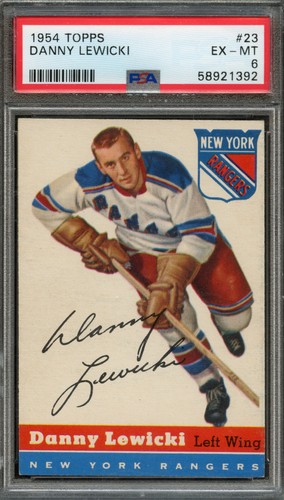
Topps began with 60 cards measuring approximately 2⅝ by 3¾ inches. The checklist covers Boston, Chicago, Detroit and New York; the absence of Montreal and Toronto is part of the issue, not evidence that your team checklist is incomplete. Color portraits, team logos and a red, white and blue layout give the set a consistent identity.
Gordie Howe number 8 is his first Topps card, not his rookie card. For a type collection, a less famous player shows the same format. Examine the blue lower border for wear and choose storage that fits the larger card or its oversized slab.
1957–58 Topps: the return in standard size
After a two-season absence, Topps returned with 66 cards in the familiar 2½ by 3½ inch size. Boston, Chicago, Detroit and New York again supply the player selection. The lower portion of the front carries the player's name, position and team identification, making a clear front photograph useful for quick sorting.
Johnny Bucyk number 10, Glenn Hall number 20, Pierre Pilote number 22 and Norm Ullman number 46 are important rookies. Do not confuse this standard-size issue with the larger 1954 cards simply because a listing describes both as early Topps. Record actual dimensions when buying an ungraded example.
1958–59 Topps: diagonal color and Bobby Hull
The 66-card 1958–59 set uses a striking two-color diagonal background. Bobby Hull's rookie is number 66, placing a major collecting target at the end of the checklist. Eddie Shack appears on rookie card number 30. Howe's number 8 famously prints his first name as Gordy.
A spelling difference on that Howe card is a documented feature, not enough by itself to establish an unusual error variant. When comparing Hull examples, evaluate centering and the entire edge as carefully as the portrait. A complete numbered set must include the last card; a large near-set may still lack its most consequential component.
1959–60 Topps: a cleaner portrait layout
Topps retained a 66-card checklist featuring the four American NHL teams. Names sit across the top, with team identification below the player image. Bobby Hull is number 47, Gordie Howe number 63, Glenn Hall number 32 and Terry Sawchuk number 42. Hull's presence here is a second-year appearance, not another rookie issue.
The design works well for a team run or a comparison of successive player portraits. In mixed lots, distinguish the horizontal name placement from the diagonal backgrounds of 1958. Check the reverse number before adding an attractive card to a want list; familiar players recur across these compact sets.
1960–61 Topps: three active clubs and retired stars
This 66-card issue changes the team picture. Its active-player selection comes from Boston, Chicago and New York, while an All-Time Greats group adds retired players. A missing Detroit run therefore does not indicate that a seller removed every Red Wing. Stan Mikita's rookie is number 14.
The front combines a posed player photograph with a solid-colored field, while the reverse includes hockey information and trivia. Keep retired-star cards on a separate line within your checklist so a team-only collection is not mistaken for the full issue. For Mikita, confirm the year and number rather than relying on the broad description vintage Blackhawks rookie.
1961–62 Topps: team blocks and the checklist card
The 66 numbers divide into Boston 1–22, Chicago 23–44, New York 45–65 and checklist number 66. Jean Ratelle number 60 and Rod Gilbert number 62 are notable rookies. A puck-shaped name panel near the lower left helps distinguish the front from neighboring seasons.
This issue introduces team and checklist cards to Topps hockey. A collector pursuing an unmarked set should inspect number 66 on both sides: filled boxes, pencil and erased writing matter even if its corners are attractive. Team blocks also make missing-card audits simple. Sort by number before assuming that a large stack contains all three clubs in similar proportions.
1962–63 Topps: inspect the blue border
The 1962–63 issue again has 66 cards and the same three-club structure. Its blue border is a practical identification cue and a useful place to look for small surface breaks. Vic Hadfield number 60 and Jim Neilson number 49 are rookie cards; number 66 is the checklist.
A bright scan may conceal edge wear where light reflects from a holder. Ask for a second angle if the blue perimeter disappears into glare. For a set assembled across several purchases, choose a consistent level of eye appeal rather than assuming that every card carrying the same numerical grade will display identically.
1963–64 Topps: portrait and action image together
Topps' final 66-card set in this sequence uses a color portrait alongside a smaller black-and-white action image, with a hockey-stick element carrying the name. The active clubs remain Boston, Chicago and New York. Jacques Plante number 45 is his first Topps card, following earlier appearances with another maker; first Topps is not synonymous with rookie.
Use both images when checking a listing against a reference. The paired layout is more distinctive than the player's name alone. A player collector can use this issue to document a change of team or manufacturer without presenting it as the start of the player's card history.
1964–65 Topps: tallboys and all six teams
The format expands dramatically to 110 cards measuring about 2½ by 4 11/16 inches. These tallboys include all six NHL clubs. PSA identifies 22 short prints, including Bobby Hull number 20, Jean Beliveau number 33 and checklist number 55. A near-set's missing numbers matter more than its simple percentage complete.
The tall shape requires a correctly sized holder and storage space. Do not press an oversized slab into a box made for ordinary card holders. In photographs, inspect both long edges and the full top and bottom; tightly cropped listings can obscure the very areas needed to judge centering and handling wear.
1965–66 Topps: standard cards with scratch-off backs
Topps returns to standard dimensions with 128 cards. A puck at the top carries the team name, and a scratch-off question appears on the reverse. Phil Esposito number 116, Gerry Cheevers number 31, Yvan Cournoyer number 76 and Ed Giacomin number 21 are important rookies. Numbers 122–128 form the short-printed closing group.
Ask to see the reverse before comparing condition. An intact scratch-off area and one that has been exposed are materially different collecting choices. Preserve the surface as found rather than scratching it to read the answer. Also distinguish a player's regular card from an All-Star appearance; Howe number 108 and number 122 are different cards.
Build an early Topps collection with a defined target
A ten-card type collection can show every issue discussed here without requiring every star rookie. A complete-set project needs more preparation: identify short prints, decide whether marked checklists are acceptable, and budget storage for the two oversized formats. Keep photographs of the front and reverse with each purchase. Those records make it easier to verify future upgrades and explain exactly what you own. A grading label helps describe condition and identity, but a clear view of the actual card remains essential.
Sources & further reading
Primary references for the terminology and factual details discussed above.
- 1954–55 Topps: an oversized debut ↗
- 1957–58 Topps: the return in standard size ↗
- 1958–59 Topps: diagonal color and Bobby Hull ↗
- 1959–60 Topps: a cleaner portrait layout ↗
- 1960–61 Topps: three active clubs and retired stars ↗
- 1961–62 Topps: team blocks and the checklist card ↗
- 1962–63 Topps: inspect the blue border ↗
- 1963–64 Topps: portrait and action image together ↗
- 1964–65 Topps: tallboys and all six teams ↗
- 1965–66 Topps: standard cards with scratch-off backs ↗
Explore the actual listings.
Read the item description, photographs, condition notes and terms on eBay. Selection and availability change.
Browse Current Sports Cards Inventory ↗Explore Graded & Collectible Sports Cards ↗