1980–81 Topps: preserve the scratch-off puck
The 264-card set hides each player's printed name beneath a black scratch-off puck. That surface is part of the original design. A card with its name exposed and one with the coating intact should not be described as equivalent without showing the difference.
For a raw purchase, request a close view of the puck and the reverse number. Do not scratch a card merely to identify the player: the number and a checklist can answer that question without altering the surface. A graded holder description and clear photographs are especially useful when the amount of removed coating is hard to see through glare.
1981–82 Topps: 198 unique cards, two regional runs
Numbers 1–66 form a shared national group. Two different groups then use numbers 67–132: an East run and a West run. Each regional combination contains 132 cards, while the combined issue has 198 unique cards. This is why a listing for a complete 132-card set is not necessarily wrong, but needs a regional description.
Record East or West alongside the card number. A number-only spreadsheet will collapse distinct cards into apparent duplicates. Before buying a full set, ask whether it contains one region or both, then verify the two regional groups rather than counting the shared national cards twice.
1982–83: no standard Topps hockey set
There is no regular 1982–83 Topps hockey base set to complete. PSA's account of the 1982 O-Pee-Chee issue explains that Topps stepped away from standard hockey cards; O-Pee-Chee continued with a 396-card release. A broad label such as 1982 Topps hockey may instead refer to another kind of product or a mistaken brand attribution.
Treat this as an identification step, not a missing numbered checklist. If a card is already in hand, inspect its back and format before filing it. Do not rename O-Pee-Chee cards as Topps simply to fill an annual slot. A documented gap is an accurate part of a Topps timeline.
1983–84: the second year of the Topps gap
Topps again did not issue a standard hockey base-card set for 1983–84. O-Pee-Chee's 396-card issue continued the annual card sequence, while stickers are a separate format that requires its own product identification. Neither fact creates a conventional Topps base checklist for the year.
For an inherited collection or old inventory sheet, preserve the original note until you can match the physical item to a public checklist. Record the correction separately so the history of the description remains clear. An intentional blank in an annual Topps display is preferable to substituting another maker's card and losing the distinction.
1984–85 Topps: a 165-card return
Topps returns with 165 cards. Steve Yzerman number 49 and Pat LaFontaine number 96 are leading rookie subjects. Beckett identifies 66 single prints, so cards were not all represented equally on the production sheets. The compact checklist should not be assumed to include every rookie found in the larger O-Pee-Chee issue.
For a near-set, check which numbers remain rather than estimating the finishing task from the total alone. For an individual rookie, confirm the Topps identity on the reverse or slab. Build comparisons from the same brand and card, since a familiar photograph can appear across more than one product.
1985–86 Topps: Lemieux number 9
The 165-card 1985–86 set includes Mario Lemieux's rookie number 9 and again has 66 single prints. Box-bottom cards associated with the release are a separate format; they do not replace missing cards in the regular numbered set.
Lemieux's importance can overshadow the rest of a set listing. Ask for a complete missing-number list and clear views of the rookie rather than relying on one dramatic star photograph. If buying box-bottom material, record that designation and its cut condition. A hand-cut packaging card should not be compared as though it were an ordinary pack-issued base card.
1986–87 Topps: Patrick Roy and uneven printing
Topps expands to 198 cards, with Patrick Roy's rookie at number 53. Beckett identifies 66 double prints. That production structure matters to set building, although it does not establish the surviving condition of any particular card offered today.
When evaluating Roy, identify the exact manufacturer and inspect all four corners, the margins and the reverse. A high numerical grade is useful information, but the photograph should still be sharp enough to show the card's presentation. For common-card purchases, avoid assuming that a stack full of repeated numbers is a representative sample of the entire checklist.
1987–88 Topps: a 198-card rookie-rich issue
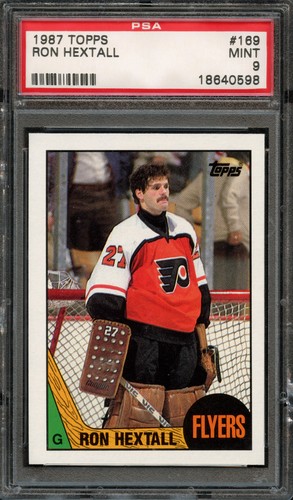
The checklist stays at 198. Luc Robitaille number 42, Adam Oates and Ron Hextall are important rookie subjects. Hextall number 169, shown with this guide, is a regular player card and should be recorded separately from his other appearances in the issue.
This is a useful season for a focused goaltender or team collection as well as a full set. Check the exact number whenever a player appears more than once. On photographed slabs, look beyond the label to the perimeter of the card; the holder's shine can obscure a small corner defect or make the margins difficult to compare.
1988–89 Topps: Hull, Shanahan and a new Gretzky uniform
The 198-card set includes Brett Hull number 66, Brendan Shanahan number 122, Joe Nieuwendyk number 16 and Pierre Turgeon number 194 as rookies. Sixty-six cards are double prints. Wayne Gretzky number 120 is also notable for showing him with Los Angeles.
Those subjects support several different collecting goals: a rookie group, a team run or a career sequence documenting Gretzky's move. Keep those purposes distinct when judging a lot. A card can be historically interesting without being a rookie. When a seller uses a loose rookie-era description, confirm the actual season and the player's earlier issues before adopting that label.
1989–90 Topps: Sakic and Leetch close the decade
Topps again issues 198 cards, including Joe Sakic number 113 and Brian Leetch number 136 as rookies. A small checklist does not make every example high grade, and the existence of a similar O-Pee-Chee card does not make the two products interchangeable.
For a two-card rookie project, record the full season, Topps brand and number with each purchase photograph. For a complete set, inspect ordinary cards and checklists as well as the rookies. This season forms a useful stopping point before the much larger early-1990s checklists and the arrival of several competing hockey-card brands.
Use three fields to prevent most cataloguing mistakes
Season, brand and card number are the minimum record; add region for 1981–82 and format for stickers or box-bottom cards. Note whether a 1980–81 scratch-off remains intact. These small distinctions make a collection easier to search, insure, sell or pass on because they describe the object rather than repeating a vague marketplace title. Keep photographs of both sides and the grading label with the record, even if your public display shows only the card.
Sources & further reading
Primary references for the terminology and factual details discussed above.
- 1980–81 Topps: preserve the scratch-off puck ↗
- 1981–82 Topps: 198 unique cards, two regional runs ↗
- 1982–83: no standard Topps hockey set ↗
- 1983–84: the second year of the Topps gap ↗
- 1984–85 Topps: a 165-card return ↗
- 1985–86 Topps: Lemieux number 9 ↗
- 1986–87 Topps: Patrick Roy and uneven printing ↗
- 1987–88 Topps: a 198-card rookie-rich issue ↗
- 1988–89 Topps: Hull, Shanahan and a new Gretzky uniform ↗
- 1989–90 Topps: Sakic and Leetch close the decade ↗
Explore the actual listings.
Read the item description, photographs, condition notes and terms on eBay. Selection and availability change.
Browse Current Sports Cards Inventory ↗Explore Graded & Collectible Sports Cards ↗