Silver Eagles: finish and reverse design
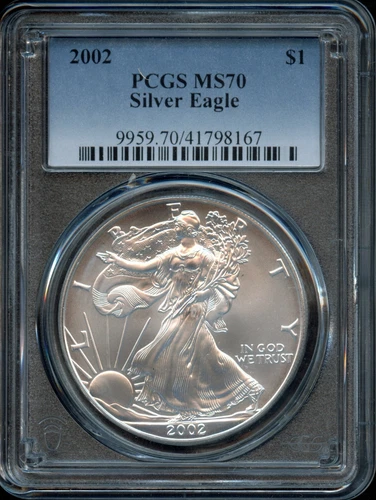
Silver Eagles began in 1986 and contain one troy ounce of silver with a one-dollar face value. The Walking Liberty obverse adapts Adolph A. Weinman’s earlier half-dollar design. That shared artwork does not make a Silver Eagle a half dollar.
Separate bullion, Proof, Reverse Proof and collector Uncirculated descriptions. They identify different products or finishes. A high grade does not turn a bullion coin into a Proof, and the word “uncirculated” in casual listing language may be less specific than an official product name.
New reverse artwork began appearing during 2021. When considering a 2021 coin, identify the reverse actually shown rather than relying on the date alone. Keep design type and finish in separate fields so a later comparison does not confuse the two.
Gold Eagles: weight is not face value
Gold Eagles also began in 1986. The familiar four sizes contain one ounce, one-half ounce, one-quarter ounce or one-tenth ounce of gold, paired with face values of $50, $25, $10 and $5. Those face values are identifiers, not statements of selling price.
The alloy is 22-karat gold. Distinguish contained gold weight from the coin’s total weight when reading a specification. An apparent difference between those numbers is not automatically evidence of an error; the alloy includes other metals.
The obverse adapts Saint-Gaudens’ Liberty design. Early issues dated 1986–1991 use Roman numerals; later dates use Arabic numerals. As with silver, the 2021 reverse transition makes exact design identification useful.
A historic $10 gold eagle and a modern $10 American Gold Eagle are different series. Include “American Gold Eagle,” weight and date in your catalogue so the denomination word does not blur that distinction.
Platinum Eagles: identify the program and design
Platinum Eagles began in 1997. The series includes $10, $25, $50 and $100 denominations in its history, and the metal specification is .9995 platinum. Do not assume that every denomination and format exists for every year.
Platinum collector issues explore changing themes. For example, the 2021–2025 First Amendment Proof series uses annual obverse designs. A Statue of Liberty portrait is therefore not a universal requirement for every Platinum Eagle issue.
Record the full official program title or design description where relevant. A year-only set and a thematic Proof set answer different collecting interests. Read the Mint’s issue page before treating a missing design as a gap in a generic bullion checklist.
Compare the coin before the label design
For all three metals, preserve the complete holder photograph, certification number and service description. Special label artwork or release wording can be catalogued separately from the physical coin. This keeps a collection understandable even if your interest in label variations changes.
Use one checklist row per distinct combination of metal, weight, date, mint designation, design and finish. Only then compare grade and eye appeal. The featured Silver Eagle image illustrates the silver member of the family; it does not depict gold or platinum.
Sources & further reading
Primary references for the terminology and factual details discussed above.
Explore the actual listings.
Read the item description, photographs, condition notes and terms on eBay. Selection and availability change.
Browse Current Coins Inventory ↗Explore Collectible, Vintage & Graded Coins ↗