1989 Bowman
The revived Bowman brand uses 484 oversized cards measuring 2½ by 3¾ inches. Ken Griffey Jr. is card 220. Use holders that accommodate the extra height, and distinguish the regular issue from the separate Tiffany factory-set version before comparing condition or filling a checklist.
1990 Bowman
Bowman returned to the standard 2½-by-3½-inch format with 528 cards. Frank Thomas, Bernie Williams and Larry Walker are among the rookie subjects. This is also a Tiffany year, so a regular 1990 Bowman checklist does not establish which finish a particular card has.
1991 Bowman
The checklist grew to 704 cards. Gold-stamped award subjects and the Rod Carew tribute give the issue recognizable subsets within the main numbering. Those base-set features should be tracked separately from an aftermarket signature or a card described only as a gold parallel.
1992 Bowman
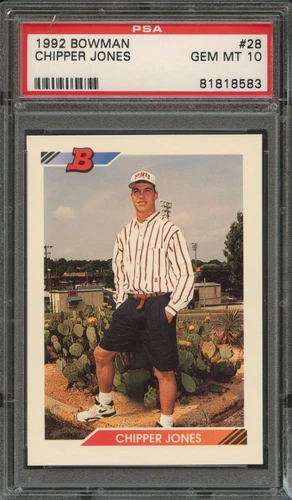
The 705-card issue combines white-stock, UV-coated cards with 45 foil cards. Mariano Rivera, Mike Piazza, Manny Ramirez and Trevor Hoffman are notable rookie subjects. Foil is part of the set's construction here; identify the actual card number before assuming a shiny card belongs to a separate parallel.
1993 Bowman
The 708-card checklist includes Derek Jeter and Andy Pettitte rookie cards. This is a much larger set than later Bowman releases, so a collection described as a complete prospect run should be checked against the full numbered checklist rather than the presence of its best-known rookies.
1994 Bowman
Bowman's 682-card release uses a borderless design, with a foil segment numbered 337–388. Jorge Posada, Derrek Lee and Jermaine Dye are rookie subjects. The foil segment belongs to the base checklist, making it a different completion task from chasing a parallel of every card.
1995 Bowman
The label “Bowman.” resolves to Bowman. Its 439-card checklist divides attention among young players, a silver-foil prospect group and established players. Preserve the card's number and finish when sorting: the different appearances are intentional checklist components, not evidence that several annual sets have been mixed.
1996 Bowman
The 385-card release introduced a full parallel and additional insert collecting to this Bowman run. Historical cards associated with the set's expired buyback promotion should be identified by the actual issue and documentation; the old printed promotion is not a current redemption or offer.
1997 Bowman
The two-series checklist totals 441 cards and distinguishes established players from prospects with red and blue design elements. Its numbering includes duplicated 156 and 159 numbers rather than ordinary 155 and 158 entries. A completion audit should follow that documented numbering quirk instead of searching indefinitely for missing numbers.
1998 Bowman
The 441-card, two-series issue uses a gold Bowman Rookie Card stamp on designated subjects. Orlando Hernández was a late addition at card 221. Do not equate that contemporary Bowman stamp with every later definition of a major-league rookie card; retain the precise issue name in a listing.
1999 Bowman
The 440 cards are divided into two equal series, each containing 70 established players and 150 prospects. This arrangement makes the series boundary useful when reviewing a near-complete collection. Paper Bowman and Bowman Chrome are separate issues even when their subjects and numbering resemble one another.
2000 Bowman
The 440-card Bowman checklist was issued as one series. That differs from the two-series structure of the preceding year and simplifies base-set reconciliation. Keep inserted Chrome cards or other Bowman-branded releases in their own groups rather than counting them toward the paper base total.
2001 Bowman
Bowman again uses a 440-card base checklist. This year sits within the period when rookie and prospect subjects are part of a large annual numbered set, before the later BP-prefix system. Record the complete set name when comparing cards with the separate 2001 Bowman Chrome release.
2002 Bowman
The 440-card checklist places established players in its first 110 positions and young-player subjects after that. This numbering split is a practical way to organize a collection, but it does not make every later-numbered card a major-league rookie card. Check the subject's exact checklist designation.
2003 Bowman
The 330-card issue separates established-player cards 1–155 from the remaining young-player cards with red and blue bottom panels. That visible design split can help sort a mixed lot. The larger Bowman product family still needs separate inventories for paper, Chrome and autograph cards.
2004 Bowman
The 330-card checklist divides into established players 1–144, prospects 145–165 and rookies 166–330. Those boundaries matter when a seller describes a lot as “all prospects.” Ask for the card-number range rather than assuming the informal description matches the checklist's categories.
2005 Bowman
This 330-card issue separates established players, rookie-year subjects and prospects within its numbering. It precedes the 2006 change to a distinct prospect insert series. A collector comparing adjacent years should therefore expect a change in organization, not a simple year-to-year continuation of identical prefixes.
2006 Bowman
The base checklist and BP-prefixed prospects became separate collecting runs. The base set contains 231 cards, with cards 219 and 220 appearing in signed and unsigned forms. Record the autograph status as part of the identification instead of treating every copy with the same number as equivalent.
2007 Bowman
The 237-card base set is accompanied by 135 Bowman Prospects cards. Hideki Okajima's card 219 has unsigned and autograph versions, including English and Japanese signatures. Those variations make a front-and-back photograph especially useful when a collection description gives only the player and number.
2008 Bowman
The 230-card base run includes ten autographed rookies at its end, alongside a separate 110-card paper prospect series. Chrome Prospects are another component. A claimed complete base set should specify whether its autograph segment is included, rather than silently counting only the unsigned portion.
2009 Bowman
The 230-card base set sits beside 90 Bowman Prospects and a 20-card World Baseball Classic group. Chrome Prospects add a further checklist. World Baseball Classic subjects should retain their subset identity in an inventory, because a player name alone does not identify which Bowman component is present.
2010 Bowman
The release pairs a 220-card base set with 110 paper prospects and a corresponding Chrome prospect program. USA Baseball subjects include Bryce Harper before his major-league debut. Bowman Expectations and 1992-style throwback inserts give this year additional projects beyond its base and prospect runs.
2011 Bowman
The 220-card base and 110-card paper prospect structure continues, with Bryce Harper appearing in the Chrome prospect checklist as BCP1. Bowman's Best also appears as an insert theme. A card using that design is not automatically part of a separate standalone Bowman's Best release.
2012 Bowman
The set retains 220 base cards and 110 paper prospects. Yu Darvish and Yoenis Céspedes are among its rookie subjects. Use the RC logo, number prefix and actual checklist together when distinguishing their major-league cards from the prospect cards distributed in the same product.
2013 Bowman
Alongside the 220-card base and 110-card prospect runs, this release includes Cream of the Crop Chrome Minis and Blue Sapphire Best Players of All Time inserts. “Sapphire” in that insert title should not be confused with the later standalone Sapphire Edition product family.
2014 Bowman
The 1989 Bowman Is Back insert theme and Silver Diamond Refractor treatment help distinguish this year's extras. Russell Wilson also has a documented variation to identify carefully. When sorting a mixed collection, keep the base, BP paper prospects, BCP Chrome prospects and insert prefixes as separate fields.
2015 Bowman
Bowman changes to 150 base cards and 150 paper prospects. Rookie Recollections, Farm's Finest Minis and Scouts' Top 100 provide recognizable insert groups. That equal-sized base/prospect structure differs from 2014 and should be reflected in any checklist built to assess completeness.
2016 Bowman
The 150-card base and 150-card prospect format continues, with Family Tree, International Ink and Turn Two among the insert themes. A family-name or two-player card can belong to an insert rather than the main run, so preserve its full alphanumeric number in a collection spreadsheet.
2017 Bowman
The base set contracts to 100 cards while the paper prospect series remains at 150. Retrospective inserts revisit 1948, 1951 and 1992 Bowman designs. The product's anniversary branding should not replace its actual 2017 issue identity when comparing an original card with a modern tribute.
2018 Bowman
This release continues the 100-card base and 150-card prospect structure. Bowman Sterling appears as part of a cross-product insert program, alongside themes such as Bowman Birthdays and Bowman Trending. A 2018 Sterling insert needs its own identification rather than being cataloged as a standalone Sterling base card.
2019 Bowman
The 100-card base and 150-card prospect structure is joined by a 30th-anniversary tribute to 1989 Bowman and Ready for the Show inserts. Sterling inserts also appear, even though standalone Bowman Sterling returned this year. The same brand word can therefore identify two different collecting contexts.
2020 Bowman
The main issue combines 100 base cards with 150 prospects. A separate Bowman 1st Edition paper prospect release adds another version to distinguish by its stamp and checklist. Spanning the Globe, Hidden Finds and a 1990-design tribute help identify this year's insert groups.
2021 Bowman
The 100-card base and 150-card prospect structure continues, with a separate 1st Edition paper issue. Futurist, Positional Promise and 1991 Bowman inserts distinguish the year's extras. “1st Edition” is a product treatment; record it separately from a player's printed 1st Bowman designation.
2022 Bowman
The base/prospect split remains 100 and 150 cards. Virtuosic Vibrations, Hi-Fi Futures, Bowman in 3D and Invicta add visually distinct insert projects. Their special designs should not be used to infer rarity without checking the precise parallel and any serial number on the card.
2023 Bowman
The familiar 100-card base and 150-card prospect runs are supplemented by Modern Prospects, Sights on September and Bowman Spotlights. Prospect and insert numbers need separate checklist columns. A player can appear in multiple components without those cards being interchangeable examples of the same issue.
2024 Bowman
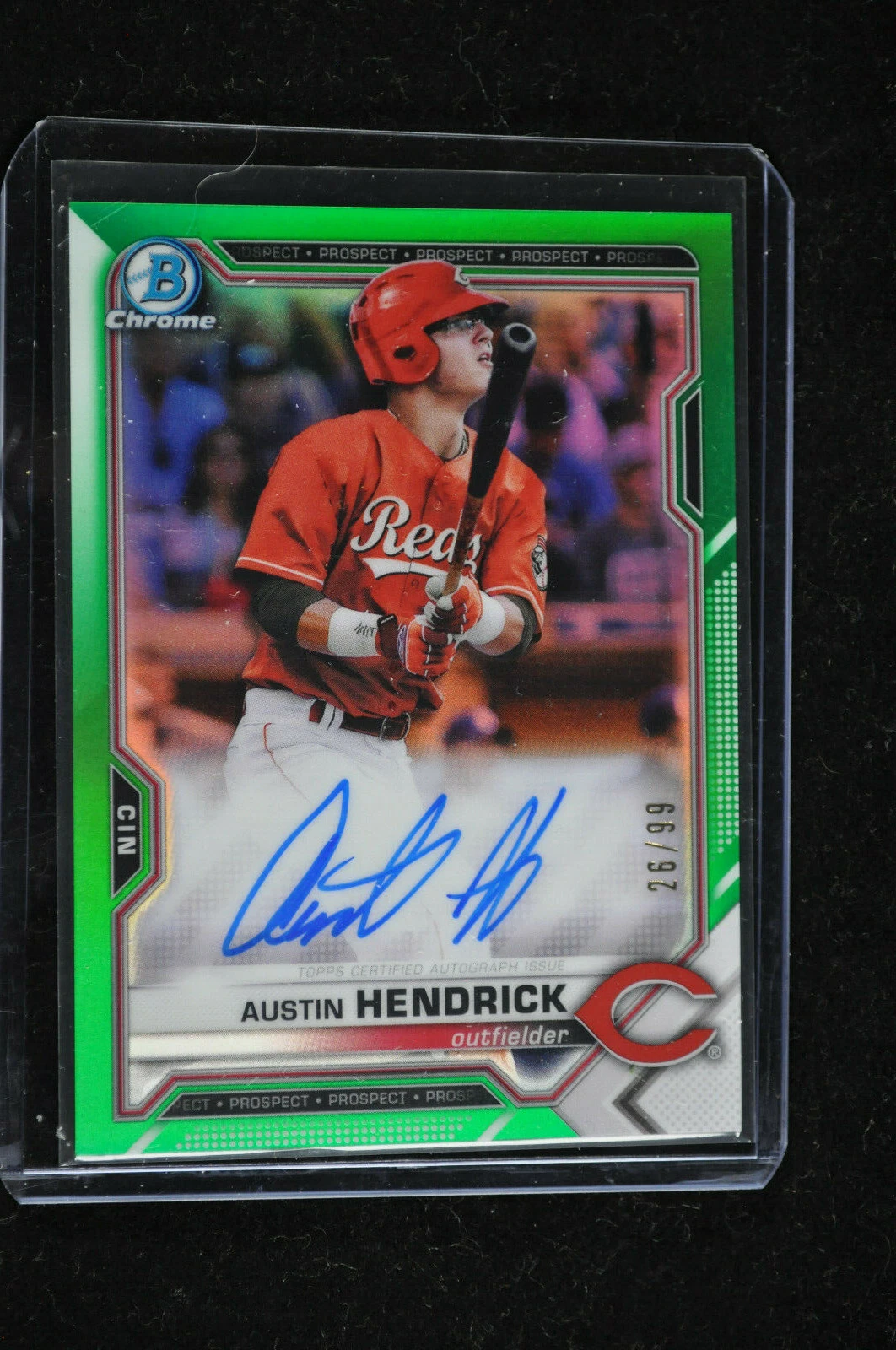
The set again contains 100 base cards and 150 prospects. Prospect Power-Up, Rising Infernos and Gladiators of the Diamond help distinguish the insert program, while Retrofractor cards require their own identification. Record the exact subset rather than relying on a front design's resemblance to a standard prospect card.
2025 Bowman
The 100-card base and 150-card prospect structure continues. Very Important Prospects, Greatness Loading, Rockstar Rookies and Crystallized are useful insert names to record when organizing the year's cards. A full collection description should separate these from both paper prospects and Chrome prospect parallels.
2026 Bowman
Topps' official product description confirms 100 base cards and 150 prospects for the 2026 release. Use the 2026 checklist when identifying the new rookie and prospect subjects, rather than carrying forward a 2025 player list. Paper base, paper prospects, Chrome prospects and autographs remain distinct inventory categories.
Sources & further reading
Primary references for the terminology and factual details discussed above.
- 1989 Bowman Description Distribution Reviews Insertion Ratios Checklist — BaseballCardPedia checklist ↗
- 1990 Bowman Description Distribution Reviews Insertion Ratios Checklist — BaseballCardPedia checklist ↗
- 1991 Bowman Description Distribution Reviews Checklist — BaseballCardPedia checklist ↗
- 1992 Bowman Description Distribution Reviews Checklist — BaseballCardPedia checklist ↗
- 1993 Bowman Description Distribution Reviews Insertion Ratios Checklist — BaseballCardPedia checklist ↗
- 1994 Bowman Description Distribution Reviews Checklist — BaseballCardPedia checklist ↗
- 1995 Bowman Description Distribution Reviews Insertion Ratios Checklist — BaseballCardPedia checklist ↗
- 1996 Bowman Description Distribution Reviews Insertion Ratios Checklist — BaseballCardPedia checklist ↗
- 1997 Bowman Description Distribution Reviews Insertion Ratios Checklist — BaseballCardPedia checklist ↗
- 1998 Bowman Description Distribution Reviews Insertion Ratios Checklist — BaseballCardPedia checklist ↗
- 1999 Bowman Description Distribution Reviews Insertion Ratios Checklist — BaseballCardPedia checklist ↗
- 2000 Bowman Description Distribution Reviews Insertion Ratios Checklist — BaseballCardPedia checklist ↗
- 2001 Bowman Description Distribution Reviews Insertion Ratios Checklist — BaseballCardPedia checklist ↗
- 2002 Bowman Description Distribution Reviews Insertion Ratios Checklist — BaseballCardPedia checklist ↗
- 2003 Bowman Description Distribution Reviews Insertion Ratios Checklist — BaseballCardPedia checklist ↗
- 2004 Bowman Description Distribution Reviews Insertion Ratios Checklist — BaseballCardPedia checklist ↗
- 2005 Bowman Description Distribution Reviews Insertion Ratios Checklist — BaseballCardPedia checklist ↗
- 2006 Bowman Description Distribution Reviews Insertion Ratios Checklist — BaseballCardPedia checklist ↗
- 2007 Bowman Description Distribution Reviews Insertion Ratios Checklist — BaseballCardPedia checklist ↗
- 2008 Bowman Description Distribution Reviews Insertion Ratios Checklist — BaseballCardPedia checklist ↗
- 2009 Bowman Description Distribution Reviews Insertion Ratios Checklist — BaseballCardPedia checklist ↗
- 2010 Bowman Description Distribution Reviews Insertion Ratio Matrix Checklist — BaseballCardPedia checklist ↗
- 2011 Bowman Description Distribution Reviews Insertion Ratios Checklist — BaseballCardPedia checklist ↗
- 2012 Bowman Description Distribution Reviews Insertion Ratios Checklist — BaseballCardPedia checklist ↗
- 2013 Bowman Description Distribution Reviews Insertion Ratios Checklist — BaseballCardPedia checklist ↗
- 2014 Bowman Description Distribution Reviews Insertion Ratios Checklist — BaseballCardPedia checklist ↗
- 2015 Bowman Description Distribution Reviews Insertion Ratios Checklist — BaseballCardPedia checklist ↗
- 2016 Bowman Description Distribution Reviews Insertion Ratios Checklist — BaseballCardPedia checklist ↗
- 2017 Bowman Description Distribution Reviews Insertion Ratios Checklist — BaseballCardPedia checklist ↗
- 2018 Bowman Description Distribution Reviews Insertion Ratios Checklist — BaseballCardPedia checklist ↗
- 2019 Bowman Description Distribution Reviews Insertion Ratios Checklist — BaseballCardPedia checklist ↗
- 2020 Bowman Description Distribution Reviews Insertion Ratios Checklist — BaseballCardPedia checklist ↗
- 2021 Bowman Description Distribution Reviews Insertion Ratios Checklist — BaseballCardPedia checklist ↗
- 2022 Bowman Description Distribution Reviews Insertion Ratios Checklist — BaseballCardPedia checklist ↗
- 2023 Bowman Description Distribution Reviews Insertion Ratios Checklist — BaseballCardPedia checklist ↗
- 2024 Bowman Description Distribution Reviews Insertion Ratios Checklist — BaseballCardPedia checklist ↗
- 2025 Bowman Description Distribution Reviews Insertion Ratios Checklist — BaseballCardPedia checklist ↗
- 2026 Bowman Description Distribution Reviews Insertion Ratios Checklist — BaseballCardPedia checklist ↗
- Topps — 2026 Bowman official product ↗
Explore the actual listings.
Read the item description, photographs, condition notes and terms on eBay. Selection and availability change.
Browse Current Baseball Cards Inventory ↗Explore Graded & Vintage Baseball Cards ↗