Classic Head cents and half cents
The large-cent series runs from 1808 through 1814. Classic Head half cents extend from 1809 through 1836, with substantial gaps in production. A printed range describes the boundaries of the series; it does not promise that every intervening date exists.
Write “no regular issue” only after checking a denomination-specific reference. An empty space in an album is not evidence that the Mint struck a missing coin. This matters especially if you create a custom year-by-year display.
Large cents: texture before tiny details
PCGS notes the difficulty of finding Classic Head large cents with attractive surfaces, including problems associated with the copper used. That makes broad surface photographs especially valuable when evaluating a candidate.
Look across the fields, around the date and between lettering. Do apparent pits continue beneath the design, or are you seeing shadows and compression? A photograph may not resolve the question. Ask for a better view instead of turning ambiguous pixels into an explanation of how the coin was made.
A lower-grade coin with clear, consistent surfaces may serve a design study well. Decide whether your aim is to illustrate the portrait, learn die varieties or pursue condition before comparing examples. Those are different projects.
Half cents: avoid filling imaginary gaps
Half-cent production pauses include 1812–1824, 1827 and 1830. The familiar 1837 half-cent token belongs to private Hard Times tokenage, not the federal Classic Head series. Its denomination wording should not override that distinction.
The 1828 half cent offers twelve-star and thirteen-star varieties. Counting the stars is an accessible first exercise, but keep it separate from grade. A readable variety can occur on a circulated coin; designation and preservation answer different questions.
A practical comparison record
Use one page per denomination with columns for date, variety reference, grade, surface notes and image source. Keep disputed identifications in a notes field. This structure allows the collection to grow without making the catalogue more certain than the evidence.
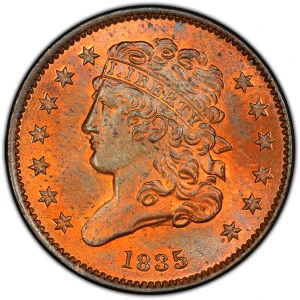
The pictured 1835 half cent illustrates the later part of that denomination’s timeline. It should not be used as a visual stand-in for an 1810 large cent. Accurate captions make a family collection easier to understand.
Sources & further reading
Primary references for the terminology and factual details discussed above.
Explore the actual listings.
Read the item description, photographs, condition notes and terms on eBay. Selection and availability change.
Browse Current Coins Inventory ↗Explore Collectible, Vintage & Graded Coins ↗