Flowing Hair half dollars: 1794–1795
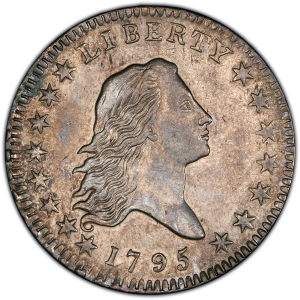
The Flowing Hair half dollar was issued in 1794 and 1795. Liberty faces right on the obverse, while a small eagle within a wreath occupies the reverse. The edge bears denomination wording, an important reminder that an early coin may communicate outside its two main faces.
When reviewing a holder, note how much of the edge can actually be seen. Do not claim to have inspected lettering that the insert covers. Reference information and direct observation belong in different parts of your notes.
Early striking and planchet preparation can leave features that require specialist interpretation. Photograph the complete fields and devices before naming a line or weak area. A diagnostic close-up is more useful when it can be understood in the context of the whole coin.
Draped Bust half dollars: the reverse divides the series
Draped Bust halves divide into Small Eagle issues of 1796–1797 and Heraldic Eagle issues of 1801–1807. There is a production gap between those groups. A continuous date range would conceal both the interruption and the major reverse distinction.
The later reverse places a shield on the eagle and includes a larger arrangement of stars, clouds and inscriptions. Compare these broad design elements before trying to identify small die markers. A readable reverse can settle a type question even when Liberty’s portrait is worn.
For a design set, specify whether you want one Draped Bust example or both reverse types. That decision changes the project substantially. Explain the scope on the display label rather than leaving viewers to infer what “complete” means.
Capped Bust half dollars: lettered and reeded edges
The Capped Bust family begins in 1807. Lettered-edge coins continue through 1836; the reeded-edge format begins in 1836 and extends through 1839. Both formats therefore occur with the transition-year date.
The reeded-edge reverse uses 50 CENTS in 1836–1837 and HALF DOL. in 1838–1839. These inscriptions provide a useful, visible way to organize a subtype study. Record them alongside the edge format instead of relying only on the familiar portrait.
Die-variety collectors use specialized attribution references, including Overton for the earlier lettered-edge series. Keep the reference system with the number and date. Do not assume that one numbering system applies unchanged to every later half-dollar format.
A collecting plan that can grow
Begin with a table of design, reverse, edge, date and attribution. A simple portrait set can later develop into a reverse or edge study without forcing you to rewrite every record. Preserve the original photographs and explain any revised identification.
In condition review, distinguish what you can see from what you suspect. A soft star may need better lighting or a same-issue comparison before its cause is clear. A detailed claim about surfaces is strongest when the photographs show the relevant area on both sides.
The pictured 1795 Flowing Hair coin represents the first section only. It should not be used to illustrate the later Draped Bust or Capped Bust portrait. Explicit captions make a family guide useful without implying that one image depicts every member.
Sources & further reading
Primary references for the terminology and factual details discussed above.
Explore the actual listings.
Read the item description, photographs, condition notes and terms on eBay. Selection and availability change.
Browse Current Coins Inventory ↗Explore Collectible, Vintage & Graded Coins ↗