Early dollars: Flowing Hair and Draped Bust
Flowing Hair dollars were issued in 1794 and 1795. The Draped Bust portrait appeared during 1795, making that year a design transition. Both series require more than a date-only image for identification.
Draped Bust dollars have Small Eagle reverses dated 1795–1798 and Heraldic Eagle reverses dated 1798–1804. The 1804-dated pieces were made later, rather than as ordinary 1804 circulation production. Treat that famous date as a specialist authentication subject, not another empty slot in a routine date run.
For a first study, compare the portrait and the complete reverse on authenticated examples. The shape and arrangement of the eagle, wreath, shield and inscriptions are more useful at this stage than memorizing a string of variety numbers.
If you move into die varieties, retain the full attribution reference and date. A number without its system can become ambiguous when collections or catalogues are combined. Save the diagnostic explanation, not just the conclusion.
Liberty Seated dollars: flying and heraldic eagles
The broader Seated-dollar story includes the Gobrecht issues of the 1830s with a flying-eagle reverse. Regular large-scale Liberty Seated dollar production begins in 1840. The later seated-figure design uses a different eagle reverse and continues through 1873.
The addition of IN GOD WE TRUST in 1866 separates the major No Motto and With Motto groups. Inspect the actual reverse, especially on a transition-year coin. A checklist that contains only “1866” leaves a type question unanswered.
A collector can choose a simple seated-dollar representative or a wider study that includes the earlier Gobrecht designs. State that choice explicitly. The specialist issues should not be added merely because an online category groups them under one heading.
Read the reverse denomination and preserve a full photograph. Seated figures appear on smaller silver denominations too, and equal-sized online images conceal the difference in physical scale.
Trade dollars: inscriptions explain the purpose
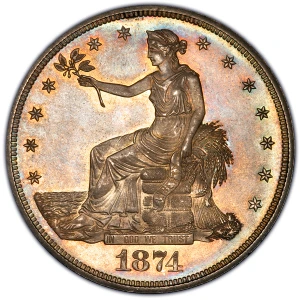
Trade dollars begin in 1873 and were developed for overseas commerce. Their reverse states 420 GRAINS and 900 FINE, as well as TRADE DOLLAR. Those inscriptions distinguish the series more reliably than the broad description “seated silver dollar.”
Circulation production continues through 1878; later dates belong to the Proof portion of the series. A full dated set is consequently different from a circulation-issue study. Keep manufacture and date together when comparing certified examples.
Some Trade dollars carry chopmarks associated with their use in commerce. Document each visible mark and retain the grading service’s treatment of it. A chopmark can be a collecting interest while still affecting how the individual coin is described.
Do not infer authenticity from a believable-looking stamp, tone or story. For an attribution or provenance claim, ask for evidence tied to this particular object. A general history of Trade dollars cannot supply an individual coin’s missing history.
A useful three-family catalogue
Use separate fields for design family, reverse, denomination wording, date, mint and certification. Then add condition and any specialist attribution. This makes comparisons possible without flattening three different series into a single “old dollar” category.
The featured 1874 Trade dollar is the representative for the final family. It is not an early Draped Bust or a Liberty Seated dollar of the regular 1840–1873 type. The caption should carry that distinction wherever the image appears.
Sources & further reading
Primary references for the terminology and factual details discussed above.
Explore the actual listings.
Read the item description, photographs, condition notes and terms on eBay. Selection and availability change.
Browse Current Coins Inventory ↗Explore Collectible, Vintage & Graded Coins ↗