Draped Bust gold: denomination and reverse
The Draped Bust grouping includes quarter eagles dated 1796–1807, half eagles dated 1795–1807 and eagles dated 1795–1804. References may also describe early portraits as Capped Bust to Right. Preserve the reference terminology with the denomination instead of assuming a shared phrase means an identical series.
The 1796 quarter eagle appears with and without obverse stars. Early half eagles include Small Eagle and Heraldic Eagle reverses, whose dated issues overlap. That makes the reverse a necessary identification field, not a decorative afterthought. A date-only photograph cannot settle the subtype.
For a first study, choose one denomination and learn its design sequence from authenticated examples. Trying to memorize all early gold portraits at once is less useful than learning which obverse and reverse belong together. Save matched two-sided images rather than collecting isolated portraits.
Capped Bust gold: a family with interruptions
Capped Bust quarter eagles span 1808–1834, but production was not continuous: after the 1808 issue, the denomination did not resume until 1821. The half-eagle family spans 1807–1834, with portrait and diameter changes within it. A broad date range must not be mistaken for a checklist containing every intervening year.
Create your checklist from actual reference entries. Add the subtype wording used for large or small diameter and portrait differences. A blank year on a homemade spreadsheet might represent no issue rather than a missing purchase.
When studying a transition year, keep the previous design visible beside the new one. Look at the whole portrait, stars, border and reverse inscriptions. This makes a design distinction easier to defend than an impression that one coin simply has a different “look.”
Classic Head gold: the 1834 transition
Classic Head quarter eagles run from 1834 to 1839; half eagles from 1834 to 1838. The new designs accompany a change in the gold standard in 1834, and omit the earlier E PLURIBUS UNUM reverse motto. Both an older Capped Bust and a Classic Head identification can therefore involve the year 1834.
For a transition comparison, transcribe the reverse inscriptions and denomination before turning to grade. A 1834 entry without design information is incomplete. The quarter eagle and half eagle also end in different years, another reason to keep separate denomination checklists.
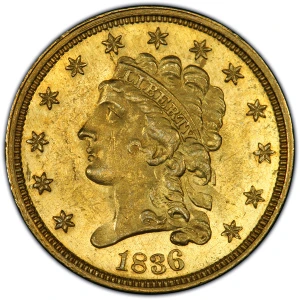
The pictured 1836 quarter eagle represents Classic Head gold only. It is not a photograph of a Draped Bust or Capped Bust piece. In a family guide, the caption should always preserve that distinction; your own collection record benefits from the same precision.
Review early gold as an individual object
Demand clear photographs of the full holder, obverse, reverse and any accessible edge. Compare certification information directly with the service record, including denomination and subtype. A matching number alone is less informative than a matching description and coin.
Keep provenance, prior sale references and observations about surfaces with the entry. Do not turn a production total into a claim about how many survive, and do not use a famous auction result as a price for a different date or condition. A useful early-gold record explains identity first, then the evidence supporting that specific specimen.
Sources & further reading
Primary references for the terminology and factual details discussed above.
- PCGS CoinFacts — draped bust 2 5 1796 1807 ↗
- PCGS CoinFacts — capped bust 2 5 1808 1834 ↗
- PCGS CoinFacts — classic head 2 5 1834 1839 ↗
- PCGS CoinFacts — draped bust 5 1795 1807 ↗
- PCGS CoinFacts — capped bust 5 1807 1834 ↗
- PCGS CoinFacts — classic head 5 1834 1838 ↗
- PCGS CoinFacts — draped bust 10 1795 1804 ↗
Explore the actual listings.
Read the item description, photographs, condition notes and terms on eBay. Selection and availability change.
Browse Current Coins Inventory ↗Explore Collectible, Vintage & Graded Coins ↗