Roosevelt dime issue groups
John R. Sinnock’s Roosevelt dime entered production in 1946. Regular circulation issues through 1964 are silver; the circulation series changed to copper-nickel clad in 1965. Later silver collector issues require their own identification, so “after 1964” is not a universal rule that every Roosevelt dime is clad.
Record the actual issue as silver or clad only when the listing, holder and reference agree. A photograph’s color is a poor composition test. Warm lighting, toning and reflections from a slab can alter the apparent metal.
What NGC means by Full Torch
The torch on the reverse has horizontal bands and vertical detail. NGC’s FT designation requires separation of the upper and lower pairs of bands and defined vertical lines. It is a strike character, not another name for the numerical grade, and NGC does not apply it to Proofs.
Compare a full reverse view with a close-up of the torch. An enlargement should resolve detail rather than merely magnify blur. If the listing contains only an obverse image, the evidence needed to discuss FT is missing.
Proofs deserve their own comparison group
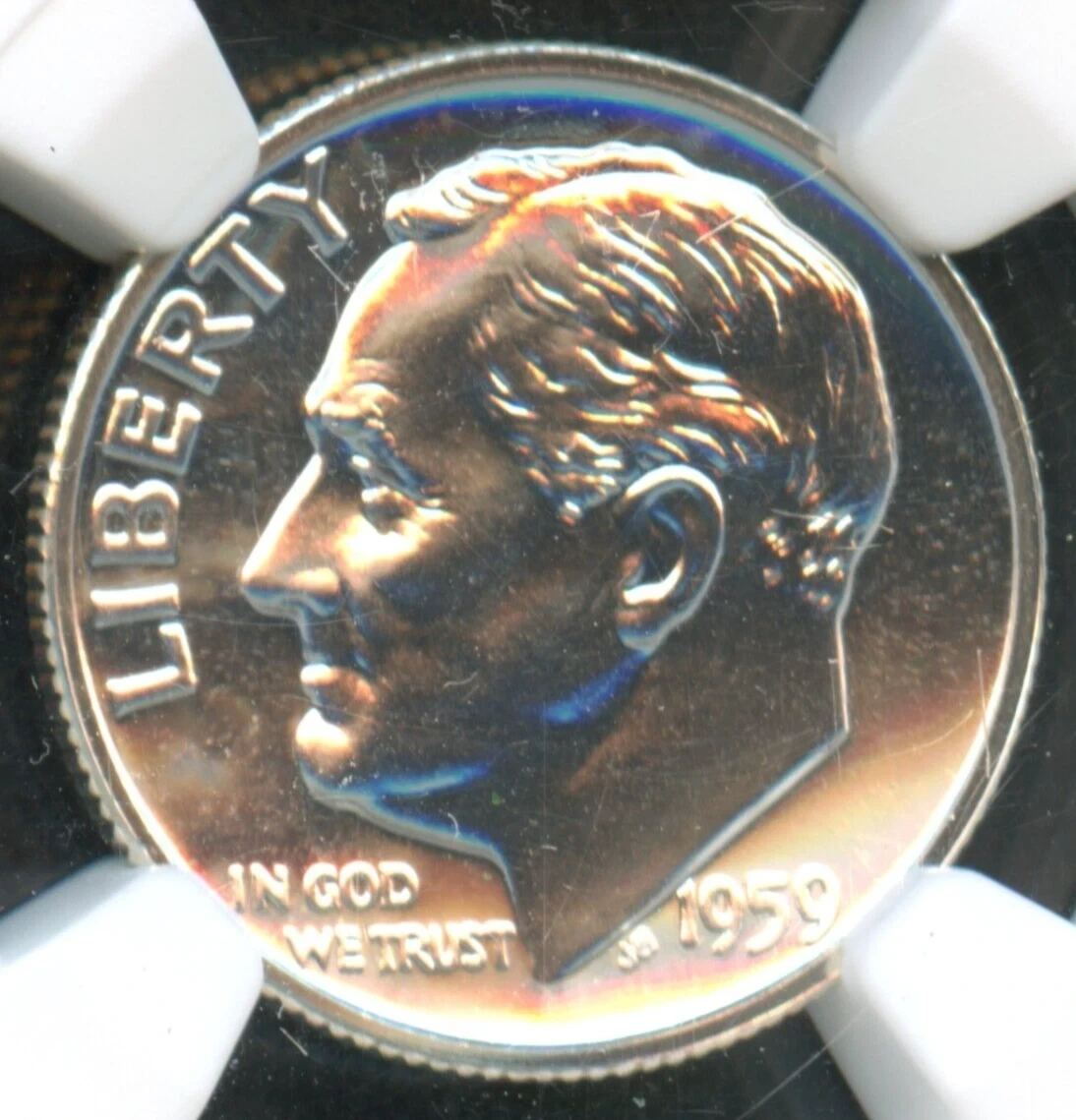
The pictured 1959 PF69 dime illustrates a Proof issue. Its label should be read as a production category followed by a grade. It should not be compared directly with a circulation strike simply because both have high numerical grades.
For a Proof-focused collection, decide whether your goal is one example per year or a study of finishes and contrast. Keep the complete service wording in your notes. Do not replace it with informal words such as “perfect” or “mirror” that obscure what the holder actually says.
A small project with a clear purpose
A three-part study can pair a silver circulation dime, a clad circulation dime and a Proof, with exact dates and descriptions attached. This teaches more than an undifferentiated pile of bright modern dimes. Expand only when you know which distinction interests you most.
Before buying, inspect the rim, cheek and open fields for the particular marks visible in the photographs. Make a short note about image limitations and request a different lighting angle if needed. Even a familiar design deserves a record of the actual coin rather than a generic stock description.
Sources & further reading
Primary references for the terminology and factual details discussed above.
Explore the actual listings.
Read the item description, photographs, condition notes and terms on eBay. Selection and availability change.
Browse Current Coins Inventory ↗Explore Collectible, Vintage & Graded Coins ↗