Liberty Seated half dollars: arrows, rays and motto
Liberty Seated halves span 1839–1891. The main type distinctions include the early absence of elbow drapery, arrows at the date, rays around the reverse eagle and the later addition of IN GOD WE TRUST. A date alone does not fully describe the design.
The 1853 Arrows and Rays type combines changes on both sides. The 1854–1855 arrows type omits the reverse rays. Later arrows appear in 1873–1874 with the motto reverse. Keep those groups separate rather than treating every arrow-marked half as the same type.
A type study can be organized around three photographs per entry: full obverse, full reverse and the distinguishing detail. This makes the collection readable without requiring a reader to already know the terminology.
When a transitional date has more than one subtype, copy the service attribution and verify the pictured feature. Do not choose a checklist slot solely because the year matches.
Barber half dollars: a new portrait in 1892
Barber halves run from 1892 through 1915. Their Liberty head and eagle reverse replace the seated figure. The design belongs to the same broad Barber family as the dime and quarter, but the denomination needs its own record and photographs.
A date-and-mint checklist is a natural way to organize the series. List the combinations actually issued rather than assuming that each year exists from every mint. Preserve variety wording, such as Micro O when applicable, as an additional attribution field.
On circulated examples, compare the portrait, lettering, rim and reverse together. One surviving word or isolated strong detail should not become a complete grading method. A useful condition record describes the coin as a whole and retains any certified qualification.
Make a two-series display coherent
Choose whether the display compares one representative from each series or attempts to show Seated subtypes as well. The second plan will be intentionally uneven: a series with more design changes deserves more than one slot.
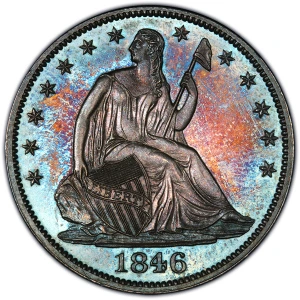
Use consistent captions and scale. If a photograph is enlarged differently, note the denomination prominently so a Barber quarter cannot quietly substitute for a half dollar. The featured 1846 image is a Liberty Seated half, not a Barber example.
Keep a short note explaining why each coin was selected: readable subtype, appealing circulation wear, or a particular mint. This turns the display into a collection with a purpose rather than a row of holders arranged by grade.
Sources & further reading
Primary references for the terminology and factual details discussed above.
Explore the actual listings.
Read the item description, photographs, condition notes and terms on eBay. Selection and availability change.
Browse Current Coins Inventory ↗Explore Collectible, Vintage & Graded Coins ↗