Walking Liberty halves, 1916–1947
Adolph A. Weinman’s Walking Liberty design appears on half dollars dated 1916–1947. Liberty moves toward the sun on the obverse; an eagle occupies the reverse. The later Silver Eagle borrows the obverse concept but belongs to another denomination and program.
Keep the face value explicit in image captions and search notes. A large image of a modern Silver Eagle can look convincing beside a half-dollar article until the reverse and specifications are checked.
The 1917 mintmark transition
On the initial issues, the mintmark sits on the obverse beneath the motto. During 1917 it moved to the reverse near the lower-left edge. Denver and San Francisco coins dated 1917 therefore include obverse- and reverse-mintmark varieties.
A title containing only the date and D or S is incomplete for that comparison. Ask for both sides and record the location as part of the issue identity. A close-up of a mintmark is useful only when you can tell where it appears on the coin.
Choose the boundaries of a short set
Common collecting scopes include 1934–1947 and the smaller 1941–1947 group. These boundaries are collection choices rather than different denominations. Spell out whether your set includes all issued mint combinations or one coin per year.
A short set can be a focused design study or a way to learn condition comparisons before considering earlier dates. It is still worth maintaining a precise checklist. “Late Walking Liberties” is too vague to establish whether the set you are building is complete.
Study strike and wear with useful photographs
Review Liberty’s central details, the fields and the reverse eagle under more than one light when possible. Soft detail may require comparison with authenticated examples of the same issue before its cause is clear. Avoid treating a single feature as a universal grading shortcut.
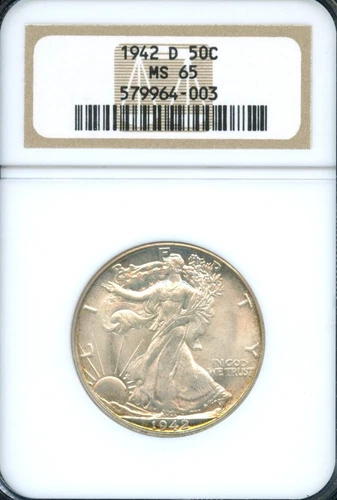
The photographed 1942-D NGC MS 65 half supplies one identifiable example for a late-date study. Its grade belongs to that individual coin. Keep its holder image and reference separate from any opinion you form about another listing with the same date.
When two candidates have the same certified grade, explain your preference in visible terms: surface marks, toning distribution or design clarity. That record is more useful than assuming one must be better because its photograph is brighter.
Sources & further reading
Primary references for the terminology and factual details discussed above.
Explore the actual listings.
Read the item description, photographs, condition notes and terms on eBay. Selection and availability change.
Browse Current Coins Inventory ↗Explore Collectible, Vintage & Graded Coins ↗