E90-1: the broad American Caramel issue
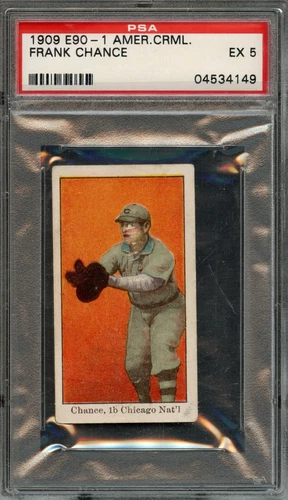
PSA dates E90-1 to 1909–11 and describes a broad, unnumbered series with color player images, bottom captions and advertising backs. Multiple poses or background treatments occur for some players. Joe Jackson is a central collecting landmark, but the set also supports team and player projects that do not depend on that single card.
A usable inventory entry includes the player, pose, team caption and any recognized background designation. Do not promote every small printing difference into a new variation: first check whether the distinction is established in the catalog or grading label you are using.
E90-2: the Pittsburgh Pirates group
E90-2 is the 1910 American Caramel Pirates issue. PSA describes 11 unnumbered cards devoted to the team that won the 1909 World Series. This narrow team focus separates it from E90-1 even though both carry the American Caramel name.
When a listing says American Caramel Pirates, compare both the portrait and the reverse with E90-2 references. A Pittsburgh player from the broader E90-1 issue does not become E90-2 merely because of his team. Keep the suffix visible in searches, saved listings and purchase records.
E90-3: Chicago Cubs and White Sox
PSA identifies E90-3 as a 20-card group featuring the Cubs and White Sox. The back’s baseball equipment illustration and American Caramel wording help identify the family. The Chicago roster makes this a logical separate project for a city collector.
Compare the depicted club with the exact set attribution. A checklist assembled by player name alone can accidentally mix E90-1 and E90-3 examples. Ask for a back photograph whenever the listing’s suffix is missing, even if the front seems familiar.
E92: Dockman, Croft’s and Nadja
PSA’s registry separates E92 Dockman & Sons Gum, Croft’s Candy, Croft’s Cocoa and Nadja Caramels. These are advertising identities, not alternate names to swap freely in a description. Related artwork across early candy issues makes a front-only attribution unreliable.
For a back-type collection, record the full printed advertisement and retain a photograph of it. Croft’s Candy and Croft’s Cocoa should occupy separate rows. A collector pursuing only one representative player may instead select a single advertising type and state that boundary clearly.
Resolve the checklist before discussing completeness
Ask what complete means: a basic subject list, recognized pose variations, every advertising back, or a specific registry composition. Those targets need different inventories. Begin with a dated copy of the chosen checklist and note the catalog used, since specialist treatment can evolve.
A good dealer description can help identify a card, but reproduce the evidence rather than simply inheriting the wording. Compare captions, artwork and backs; then check that the certification record matches the holder. An unresolved attribution should remain a question in the inventory until the photographs or an expert examination resolve it.
Choose condition compromises deliberately
Small prewar cards invite enlargement, and that is useful for examining folds, edge cuts and missing paper. Look at the face, the printed name and the advertisement as separate areas of interest. A crease may leave the identifying details intact, whereas reverse loss can remove the very brand name you are collecting.
Before purchasing, decide whether you are buying an attractive player portrait, a particular advertising back or a difficult checklist entry. That decision helps you compare two differently flawed examples without assuming that the higher numerical grade is automatically the better addition.
Sources & further reading
Primary references for the terminology and factual details discussed above.
Explore the actual listings.
Read the item description, photographs, condition notes and terms on eBay. Selection and availability change.
Browse Current Sports Cards Inventory ↗Explore Graded & Vintage Baseball Cards ↗