1969 Topps: a changing roster and lettering varieties
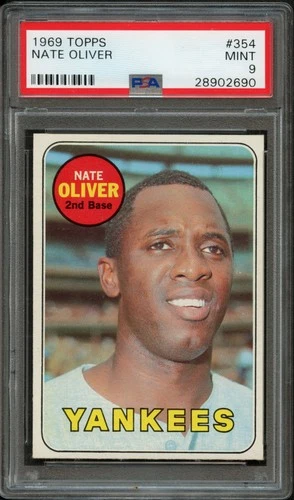
The 664-card 1969 set includes Mickey Mantle’s final regular Topps card and rookie appearances by Reggie Jackson, Rollie Fingers and Bobby Bonds. Team lettering sits below the photograph, while a circle contains the player’s name and position. Certain cards in the 440–511 portion have white-letter and yellow-letter versions.
A white-letter claim needs a clear front photograph and the correct card-specific attribution. Do not generalize that distinction to every card in the numerical range. Keep the ordinary checklist and selected lettering varieties separate so an optional specialty pursuit does not make a basic set appear perpetually unfinished.
1969 inserts are separate collecting projects
Deckle Edge cards and small decals were also associated with the 1969 product. Their shape, size and checklist differ from the regular 664-card issue. A lot described broadly as 1969 Topps can contain more than one of these formats.
Identify the format before recording a card number or comparing a price. A familiar player may appear on the regular issue and an insert, but those are separate objects with different condition considerations. Keep a small insert in storage suited to its dimensions rather than forcing every format into the same page or holder.
1970 Topps: the gray frame
The 1970 set expands to 720 cards. A thin white line separates the color photo from the gray surrounding border, and the player’s name appears in script near the bottom. Team cards return, alongside league leaders, postseason highlights and All-Stars. Thurman Munson appears on a Yankees rookie card.
Gray borders make edge wear and pale corner disturbances readily visible. Inspect the entire frame against a contrasting background, then evaluate the image and reverse separately. A clean portrait cannot compensate for a heavily disturbed border if the border is central to the display you want.
Late numbers and partial-set claims
High-number cards matter in a 1970 set-building plan. They include important subjects as well as ordinary players, so the missing-card list should identify names and numbers rather than just the quantity absent. A large low-number lot can be a useful start without being close to the practical finish line.
For 1969, also ask whether the seller’s completion claim includes any lettering variations or inserts. Those additions can make two advertised complete collections differ substantially. Write down the exact boundary you use and compare collections against that boundary instead of relying on sales shorthand.
Making a useful two-year collection
A favorite-player pair is a clear way to compare the designs. A team collection can highlight the return of team-photo cards in 1970, while a broader historical group can emphasize the 1969 rookie class and Mantle’s farewell. Confirm the actual checklist entry for each objective before buying.
Retain complete front-and-back photographs and any certification details. Record whether a signature is printed or added, whether a card is a regular issue or insert, and which variation is claimed. For market comparisons, match those attributes first; the same player and adjacent years do not make two cards interchangeable.
Sources & further reading
Primary references for the terminology and factual details discussed above.
Explore the actual listings.
Read the item description, photographs, condition notes and terms on eBay. Selection and availability change.
Browse Current Sports Cards Inventory ↗Explore Graded & Vintage Baseball Cards ↗