1972 Topps: colorful arches and a long checklist
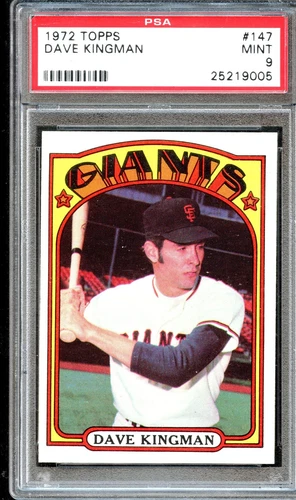
The 1972 set contains 787 cards with bright, arch-shaped picture frames and prominent team lettering. In Action cards sit alongside ordinary portraits, giving some players multiple distinct appearances. Rookie subjects include Carlton Fisk, Don Baylor, Cecil Cooper and J.R. Richard.
A player collection should list regular and In Action cards separately. For a complete set, track later-series needs explicitly rather than assuming a large mixed lot represents the whole distribution. Inspect the colored design elements for print clarity and damage, and keep all four white borders visible when judging centering.
1973 Topps: photography and the last series-based release
The 660-card 1973 issue uses white borders and a small player silhouette to identify position. Action photography is an important part of its character. Mike Schmidt appears on a shared rookie card with Ron Cey and John Hilton, and Willie Mays has his final regular active-player Topps card.
This is the last annual Topps baseball set issued through the traditional series sequence before the full-set approach of 1974. Later numbers therefore remain a practical part of a collecting plan. Record shared rookie cards by number and full identity, and avoid confusing a famous player shown incidentally in an action photograph with the card’s named subject.
1974 Topps: one series and Washington variations
The 1974 basic issue also has 660 cards, but Topps released the full checklist together. Some Padres cards were initially printed with a Washington, National League designation amid a contemplated team relocation, then appeared with San Diego identification. The proposed move did not turn those cards into a separate Washington team issue.
When pursuing these variations, check the exact front wording and relevant checklist attribution. A complete basic set and a collection that includes every Washington version are different goals. Do not apply the prior years’ high-number assumptions merely because a card has a large number on its back.
How to compare partial sets across the transition
For 1972 and 1973, break a missing-card list into the appropriate series or checklist groups. For 1974, focus instead on basic numbers, important subjects and the specific variants you want. This prevents a collection plan from carrying an outdated scarcity assumption from one year into the next.
Ask for condition notes on checklists, team cards and special subsets as well as stars. Marked checklists can affect a set even when the main player cards look clean. A quantity of duplicates should never count as additional progress toward a unique-card checklist.
Choosing a visual or historical theme
A three-year type collection can show the move from 1972’s vivid graphics to 1973’s restrained action format and 1974’s team banners. A player project can include the In Action and shared rookie formats without committing to every basic card. A team project should state whether special subsets count as required appearances.
Use full photographs to evaluate centering, edges, creases and reverse markings. Match the actual issue and variation before comparing prices, and preserve the image that proves any specialty attribution. The most useful inventory records both what the card is and which role it serves in the collection.
Sources & further reading
Primary references for the terminology and factual details discussed above.
Explore the actual listings.
Read the item description, photographs, condition notes and terms on eBay. Selection and availability change.
Browse Current Sports Cards Inventory ↗Explore Graded & Vintage Baseball Cards ↗